French Horn Tutorial
By Terry Dwyer
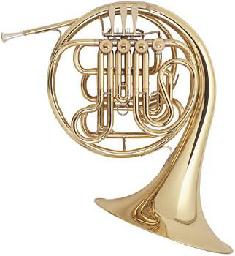
1) The Instrument
The French Horn (hereinafter called the Horn – it’s what it’s called in
Europe, anyway; there’s nothing really French about it) is made of brass, but
horn players do not like to be considered brass players, rather “horn players”
(privately believing themselves a cut above brass players). And why not? The
horn is a more difficult instrument to play, and has usually a more important
part to play, and more notes to play, than anyone in the main brass section in
the symphony orchestra. (It’s another story in band music, of
course.)
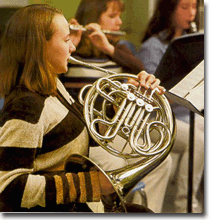
But what other brass instrument is not only put near the back of
the orchestra, but has its bell facing backwards, and the player’s hand stuffed
into it, muffling the sound? Oh, and played left-handed into the bargain.
Something of a handicap from the start, wouldn’t you say?
Why the hand
in the bell? Originally the idea of the inserted hand was to make possible notes
which were missing from the old valveless horn. Pushing the hand in the bell
lowers the pitch in varying degrees, unless it is jammed in really tight, when
it suddenly jumps up a semitone. More of this later. Once the idea of supporting
the bell with the right hand became established, things stayed that way after
the valves were added. Although the valve system makes possible a complete
chromatic scale, the right hand is still inserted for two reasons: 1) Having it
there tones down the brassiness, giving the horn a more rounded and warmer sound
which had become valued in its own right; 2) In certain circumstances it can be
difficult to be dead in tune, and the hand is able to correct pitching
errors.
[To see how the hand works: - extend your right hand forwards
a little, as if about to shake hands. Now close the fingers and thumb together,
just to seal the gaps between them. Keeping the fingers still pointing forwards,
now bend the wrist leftwards and forwards a little. The base of the wrist would
lie across the horn’s bell. The extent to which you do this would decide how
much you modify the brassiness. In the true “stopped horn” effect, the hand
virtually seals off the air exit. In normal playing it is just
partial.]
The modern instrument has a few variations, but the preferred model is
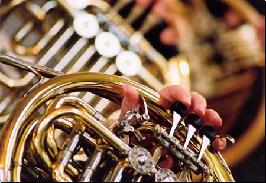
the so-called Double Horn in F and Bb. Three valves control the pitch as in a
trumpet, and a fourth thumb valve switches between the F and Bb divisions. This
duality concerns only the player; the composer and conductor being aware only of
“Horns in F” which is the only key used in modern scores, in spite of many other
keys appearing in earlier music. Always write for horns in F, sounding a perfect
fifth lower than written.
The power of the Horn
If the hand came out of the horn and the
bell faced forwards, the instrument would be about as powerful as the other
brass, but as things are, the horn is not only quieter, but the rapid
articulations possible on a trumpet are not really viable, the instrument being
a trifle sluggish, and more than a trifle sluggish on its lowest notes. So horns
are seldom asked to play really quick passages, and long holding notes are a
stock-in-trade of the orchestrator.
In dynamic power the horn lies midway
between the woodwind and brass, so can associate happily with either. It is
capable of a gentle pp which can efface itself in any context, and also
of a savage ff or even fff, though the latter will not be of the
earth-shaking character of the heavy brass. For this reason, the orchestrator’s
rule of thumb is that above mf you need two horns in unison to equal one
trumpet. As four horns are usually found, a good fanfare could be played in
four-part harmony by giving trumpets the top two parts, and the two lowest parts
with two horns per part. (Of course two trombones could have taken the lower
parts with a better blend, but it all depends on what effect is wanted, or
perhaps the whole thing is too high for trombones.)
Turning to the
woodwind, with which the horns very often join in, by keeping their volume under
control the horns can virtually be considered part of the group. For this reason
the horns appear in the score just below the woodwind, above the trumpet staves,
even though they are lower in pitch.
Tonal Blending
The really
great asset of the horns is their blending power. They blend with practically
anything, though least with oboes as you might expect. They can have a
thickening effect doubling strings, clarinets or bassoons. Clearly they are at
home with the brass.
Because of their alto/tenor pitch range, horns
often provide inner harmony suitable as a back-drop to counterpoint in the other
groups. It is also surprising how well they can hold things together with just a
single chord or interval whilst others move around them. In a nutshell, the
horns are, or can be, the glue of the orchestra. (In the language of pop music,
the pad.) It is difficult to imagine a situation where they would sound out of
place. But note carefully that a single horn will stick out like a soloist: two
or more horns blend in with other people much better. Read on.
Horns
hunt in pairs
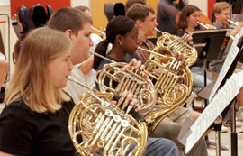
For a long time horns were always found in pairs, just like
the woodwind. With a few exceptions, two horns was the norm in the classical
period of Haydn and Mozart. Most of Beethoven’s orchestral music uses two, and
four only became the norm in the latter part of the 19th century. Even today
four horns is the usual arrangement, though virtually any number is
theoretically possible. For historical reasons the four-horn arrangement splits
itself into two unexpected pairs: Horns 1 & 2 on one stave and Horns 3 &
4 on another. The unexpected thing is this: that the 3rd horn is given a higher
part than the 2nd. The accepted pairing meant that 1st hornists specialised in
the higher range of the instrument, and 2nd hornists the lower. So when the
other pair (3 & 4) arrived, they too were a high and a low specialist,
dovetailing into the first pair. One more time: SATB harmony is Horns 1,3,2,4
pitchwise even though placed 1,2,3,4 in the score.
Muting
There are two ways to mute (or should I say further
mute) the sound:
1) Hand stopping. The score instruction stopped, bouché,
chiuso, or gestopft, (cancelled by open, ouvert, aperto, or
offen) asks the player to ram his hand firmly into the bell, sealing it
tightly. This creates a muffled sound. [It also causes the pitch to rise a
semitone, but it is the player’s business to transpose it back, so we needn’t
worry about this.] Can also be indicated by a cross + over the note, though this
implies forcing the sound to make it distinctly brassy (cuivré).
2)
Muting (con sord.). Horn mutes again give a quieter sound, though this is
not identical to stopping, in spite of the way many composers and players ignore
the difference.
2) Writing for Horns
I’m assuming you are writing for actual performance. Even if you are not, you
want your recording to sound like a real orchestra, right? So write only what is
practical for live players.
Range
The range provided in GPO for
all the horns is the theoretical range of the horn, but few players would be
able to cover all those notes with any certainty. In any case, high and low
hornists specialise in the upper or lower part of the total range, and may even
use different mouthpieces to facilitate this. So it is best to envisage two
different ranges: one for horns 1 and 3, the other for horns 2 and 4. Even
there, players are not happy at the extreme ends of the range. Have a look at
this table, in which I suggest ranges which are safe and
practicable: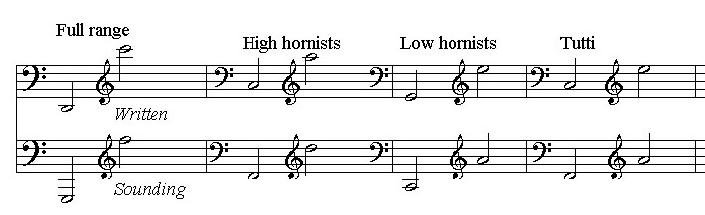
The Full range is the complete gamut available in GPO. To be safe, stick
to the High hornists’ range for players 1 and 3, and to the Low hornists’ range
for players 2 and 4. If all four horns are to play in unison, then stick to the
Tutti range or there could be some mistakes.
The 1st hornist can play the
highest three notes Bb, B and C, but they are so close together embouchure-wise
that it is all too easy to hit the wrong one if approaching by leap, so he would
prefer to arrive at them with a scale passage, thus: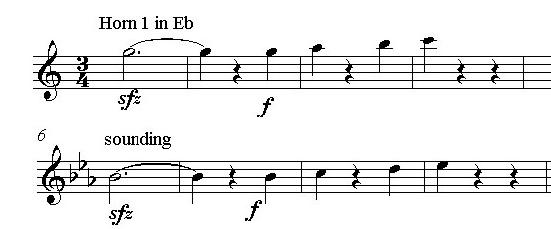
Jean Sibelius makes it a little harder to hit the same top note
here: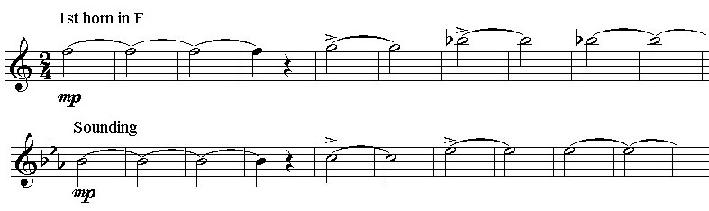
And, considering horns 2 and 4, the bottom notes of the horn (which
“speak” more slowly) can also be unsteady. The player needs a fraction of a
second to ensure that his note is right. Do not write fast passages low down
below C3 (sounding); long notes are safer. And mostly keep off very low notes
altogether; they never sound pretty, and should be used only when you need a low
sustained note which other instruments are too busy to
provide.
Articulation
As I mentioned earlier, horns are not
suited to fast articulation. If they must play a fast passage, it is better to
split the melody between two horns, especially if there are leaps:
Notice the overlapping notes, a standard device in orchestration to
secure continuity. Also, if you have the score of Britten’s Young Person’s
Guide, see how the composer treats all four horns when they first enter the
final fugue.
Breathing
All wind players must breathe, and
hornists are no exception. However, a lot depends on the volume level, also the
amount of movement. A single quiet note can be held for a surprisingly long time
(say 6-8 bars of slowish tempo) but moving passages, especially if loud, require
breathing spaces more frequently. In the next example the composer wanted to be
sure his player would have plenty of breath to maintain the power and continuity
in this important solo: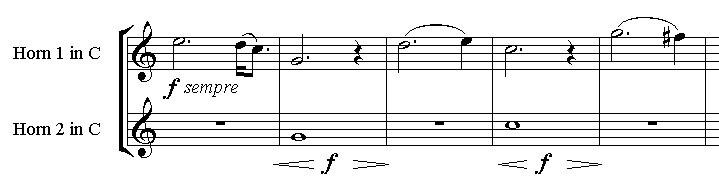
Of course, it isn’t a true solo, but the careful overlapping makes it
sound like one. Notice how the 2nd horn must begin each note quietly, so as to
insinuate himself into the texture. Horns in C sound an octave lower than
written, by the way. Horns always transpose downwards.
Horn styles
In order of frequency, probably:
1) Sustained notes As
mentioned above, holding chords, from 2-part to 4-part (or even more, if you
fancy a large horn section). This is the commonest orchestral function for
horns.
2) Repeated notes Like the other brass, horns are well
suited to repeated notes, so chords can well stand the idea of beating out a
rhythm. Almost any note values will serve, but a useful formula is
this:
Known sometimes as the “anxious” rhythm, it imparts a nervous energy to
the texture.
3) Melodies
A horn solo is one of the most
beautiful sounds in the orchestra. It can sound romantic, sombre, cheerful, or
majestic according to style. Remembering that one horn alone will tend to stick
out anyway, you’d be best generally to use more than one horn if you don’t want
a solo effect.
Another way to play a melody is horns in octaves – this
always sounds well. This could be a countermelody instead of the principal one.
Obviously the range will be a little restricted.
Finally, three or four
horns could play in contrapuntal or semi-contrapuntal style.
4)
Rests
Everybody should have a rest now and then, you know that. Just
be careful that you don’t get so addicted to that very useful “warm wad” of horn
chords holding everything together that you forget the wearying effect on the
listener. He may not know why it’s wearisome, but could well feel it.
5)
Tricks
Horns can play trills, glissandi, multiphonics, etc. If you are
a trickster, look them up in the orchestration books. I do not recommend them
for most people.
Functions in the score
1) Solos
Already mentioned. Keep your solo in the middle part of the range for
preference, i.e. within the confines of the treble stave in the written
part.
2) Leading group With a reasonably light accompaniment, the
horn section can make their mark even p or mf. See next example: 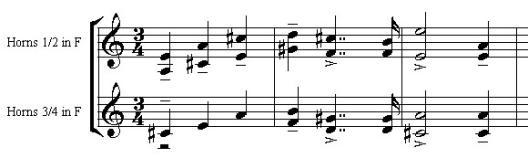
Note: when the harmony is only 3-part, you can either omit the 4th
horn, as here in the first bar, or have the 3rd horn double the 1st in unison to
strengthen the melody, with the 4th horn playing the lowest part and the 2nd
horn the middle. Tchaikovsky might well have scored the passage as
follows: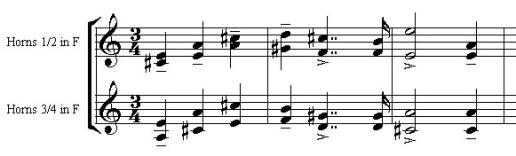
This sort of scoring is quite common. Compare it carefully with Ex.
7.
3) Background group Already mentioned, this is a constant
function of the horn group – two or more horns playing chords or long holding
notes. I mentioned in my woodwind tutorial that Mozart, in The Marriage of
Figaro, used only partial woodwind during most of the opera. He never
neglected the horns, though, even though their gamut was severely restricted to
the tonic chord plus a short scale C-G at the upper part of the stave (written
notes). In the entire opera, Mozart omitted the horns in only three concerted
items, and two of those were for strings only. In other words, horns were
regarded as essential members of the woodwind group. Why? Because of their
pleasant tone and warm blending qualities. They didn’t play in every bar, of
course, but played whenever a slightly thicker texture than minimum was
required. You can do the same, with two, three, or four horns, used with
discretion. With our modern valve-horns, you will be more ambitious than
sticking to the tonic chord!
4) Part of the brass group In
passages for full brass, the horns can certainly join in. They will quite likely
double existing notes, as it is better that the heavy brass complete all the
notes of the chord, though the “two horns = one trumpet” formula can still work,
allowing the horn parts to lie between the trumpets and trombones. Another way
is to interleave the horns between the brass parts, e.g. Tr Tr Hn Tr Hn Trom Hn
Trom Hn Trom Tba.
5) Doubling a melody Either at unison or octave
lower, horns will strengthen and give body to a melody on most other
instruments. Hollywood scorers are particularly fond of horns an octave below
the 1st violins in a powerful or romantic melody, taking the horns quite high
sometimes for a strong emotional effect. Also, four horns, 1st and 2nd violins
all in unison create a very powerful sound of great warmth.
6) Laying
out the parts I have made two things clear: first, that four horns is the
normal number; second, that 3rd horn should be given a higher part than 2nd
horn. Even with this set-up, there is no need to feel totally bound by these two
principles. The number of horns playing at any one time must be dictated by the
needs of the situation, so now we can start laying down a different set of
rules:
b) Remembering that one horn alone will tend to feel like a soloist, if there is only one melodic strand available for the horns then have two horns in octaves, or all four taking the same octaves.
c) For 2-part harmony, use horns 1 & 2, with horns 3 & 4 taking over for a spell, maybe using note overlapping; OR 1 & 3 on top part, 2 & 4 on lower.
d) For 3-parts, either 1 3 2 or 1/3 2 4 as illustrated above.
e) Four parts is of course 1 3 2 4, but watch that 4th horn doesn’t spend miserable minutes groping for low growling notes. Get him up on the stave. Chords of 7th or added 6th sound very good in close harmony.
7) More or less than four horns Odd numbers (3, 5, 7) are rare and
we most likely stick to the pairs system. So:
a) Two horns. If the
orchestra is not very large, four horns could overweigh things. Many a good
piece has been written with no more brass than two trumpets and two horns. (The
four can make reasonable brass chords if interlocked Tr 1 Hn 1 Tr 2 Hn 2. Also
Hn 1 Bsn 1 Hn 2 Bsn 2 can pass as four horns.)
b) You may quite often see
five horns in an orchestra. The odds are that this is not the number
specified by the composer, it is the common practice of providing a spare
hornist (sitting on the right as you view them) to “bump up” the 1st horn
player, i.e. taking over the easy or noisy bits so as to save his lip for the
important solos. In other words, one or other of the two plays the first horn
part by mutual arrangement.
c) Six horns. For a large orchestra. The
extra two (one high and one low player, remember) can be considered as extra
weight to be placed wherever necessary, or a doubling for three-part harmony,
with two horns on each part. Or whatever.
d) Eight horns. Gosh, you
are extravagant. Similar to six, but now you can double four parts. Mind, you
will need plenty of heavy brass to balance, plus at least twelve woodwind, not
to mention a good body of strings… Who’s paying for all this?
e) The
“a 2” problem You may be aware of the wavering/phasing effect when two
instruments of the same type play in unison. This is also true of horns, but it
seems to matter little, probably because this sort of thing would be covered up
by plenty of other stuff going on. It was even an old tradition to double horn
notes in unison where convenient, to give greater security. This should not be
necessary today except in amateur orchestras. Unison doubling should be done
because you feel the line needs the strength of two instruments.
3) Further study
a) Consult the standard orchestration books.
b) Study scores!
c) Study
scores!
d) Study scores!
Enjoy! Even take up playing the French Horn –
you won’t regret it.
Terry Dwyer
November
2004